
The Enforcement Directorate conducted searches at premises linked to Punjab industries minister Sanjeev Arora as part of a FEMA probe into alleged foreign exchange violations, insider trading, and round-tripping of funds.

US President Donald Trump announced that a peace deal with Iran, which includes a commitment from Iran to abandon nuclear weapons, is nearly complete and expected to be signed in Europe this weekend. This development follows Trump's decision to call off military strikes against Iran hours after threatening to take control of its oil industry.
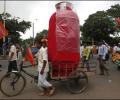
The Haryana government is taking strict action against black marketing of cooking gas cylinders, registering FIRs and seizing hundreds of cylinders to ensure adequate supply for citizens.

'Given that India underperformed emerging markets by 28 per cent in 2025, the worst performance in over 30 years, the timing of the sharp STT hike could have been better.'

The Reserve Bank of India's Financial Stability Report indicates that the interim peace deal between the US and Iran has favourably shifted the balance of risks, reducing headwinds from the West Asia conflict. However, it cautions that exchange rate volatility could increase if crude oil prices spike due to delayed normalisation of supply chain disruptions.

Divestment has emerged as a priority for the government following a moderation in direct tax collections.

India's domestic passenger vehicle sales experienced a robust 24.6 per cent year-on-year increase in June, propelled by favourable government policies like income tax relief and repo rate cuts, alongside resilient rural demand, even as global crude oil prices pose potential cost pressures.

Indian stock market benchmarks Sensex and Nifty rebounded by over 1% on Monday, driven by value-buying in banking stocks after a three-day slump. Key gainers included UltraTech Cement, HDFC Bank, and Mahindra & Mahindra.

Indian equity benchmark indices Sensex and Nifty tumbled over 1 per cent for the third consecutive day, driven by a sharp rally in crude oil prices, massive selling in IT stocks, and unabated foreign fund outflows amid ongoing geopolitical tensions in the Middle East.

Indian benchmark stock indices Sensex and Nifty rallied for the second consecutive day, closing nearly 1 per cent higher, driven by gains in metal and auto sectors and positive global market trends.

Uncertainty surrounds the US-Iran talks as a two-week ceasefire approaches its end. Pakistan is attempting to mediate, but tensions remain high after a recent naval incident.

A special SEBI court convicted two directors and their five firms, linked to late stockbroker Harshad Mehta, for failing to provide information during a 1998 investigation into the manipulation of shares belonging to BPL and Videocon.

Indian benchmark indices Sensex and Nifty experienced a sharp decline in early trading due to escalating tensions in the Middle East, driving crude oil prices higher. Global market bearishness and foreign fund outflows further contributed to investor unease.

Early data from the World Cup indicates that sportswear giant Adidas is currently gaining a significant advantage over rival Nike in brand visibility and sales. Adidas, an official sponsor, is seeing a substantial surge in apparel spending and foot traffic, particularly driven by jersey sales. While Nike's business is also growing, it is being outpaced by Adidas, which appears to have a more resonant product offering. Nike, facing declining market share and intense competition, is relying on the World Cup for a boost, though its footwear presence remains strong.
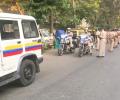
Mumbai Police's 1930 cyber helpline has successfully intercepted and frozen over 101 crore defrauded from citizens in the last five months, preventing significant financial losses.

State-owned Bank of Baroda (BoB) has agreed to pay $600 million (about 5,700 crore) to settle litigation arising from the collapse of NMC Health, ending years of cross-border legal proceedings.
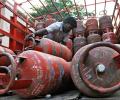
The District Supply Department in Nanded conducted a raid on a residence, uncovering an illegal stockpile of LPG cylinders and initiating legal action against the individual involved.
The Haryana government is taking strict action against individuals involved in the black marketing of cooking gas cylinders, resulting in multiple FIRs and the seizure of hundreds of cylinders.

The Centre has reviewed the monsoon situation, noting a reduced rainfall deficit and ongoing preparedness for the kharif season amidst El Nino concerns. A high-level meeting chaired by the Principal Secretary to the Prime Minister discussed measures across various sectors, emphasising continuous monitoring and coordinated action to mitigate potential impacts on agriculture, water resources, and essential commodities.

Titan Company's ambitious roadmap to achieve a 20 per cent revenue compound annual growth rate (CAGR) by financial year 2030 (FY30) has garnered a positive outlook from analysts, who highlight the company's strong brand, sourcing capabilities, and diversified portfolio as key strengths.

The Indian government is accelerating its sale of minority stakes in state-owned companies, including a significant offer for sale (OFS) in Life Insurance Corporation of India (LIC) expected "very soon," to meet its 80,000 crore mobilisation target and reduce its holdings to 75 per cent in most listed PSUs by year-end.

The Indian government has issued a stern warning to industrial users who are reportedly procuring cheaper retail fuel instead of industrial-grade fuel, leading to significant losses for state-run oil marketing companies (OMCs) and potential local shortages. This diversion, driven by a substantial price difference between retail and bulk diesel, is adversely impacting OMCs, which are absorbing daily losses of approximately 550 crore to keep retail prices stable.

These new provisions are expected to help heirs access securities faster.
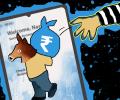
Delhi Police have arrested five individuals for allegedly supplying mule bank accounts to cyber fraud syndicates with links to Dubai. The arrests follow a complaint regarding a stock market investment scam where the victim was duped of over Rs 12 lakh.
The Haryana government is taking strict measures to combat the black marketing of cooking gas cylinders, registering FIRs and seizing hundreds of cylinders. Officials assure citizens of sufficient LPG supply despite global concerns.

Not a single retail outlet ran dry. Every household that wanted a cylinder got one. India faced neither a 1991 moment nor a 2013 one. Macroeconomic stability held. This was not an accident, and it was not luck alone. It was the work of a government that chose to act as it had during the pandemic -- deliberately and gradually, building one measure upon another rather than reaching for a single dramatic lever, explains V Anantha Nageswaran, chief economic advisor to the Government of India.

Indian paint majors, including Asian Paints, Berger Paints, and Kansai Nerolac, reported better-than-expected performance in Q4FY26, driven by steady demand, improved product mix, and strategic price hikes. The sector is also benefiting from reduced competitive intensity as new players also increase prices, narrowing the gap with incumbents.

Accenture's revised annual revenue growth forecast and weaker-than-expected fourth-quarter guidance have sent shockwaves through the Indian IT sector, causing major IT stocks and the Nifty IT index to tumble significantly.

President Trump has been briefed on potential military actions against Iran, including strikes on infrastructure and control of the Strait of Hormuz, even as negotiations continue. He maintains economic pressure is the primary strategy, while legal questions arise over war powers.

'Dark patterns exploit human psychology, cognitive biases, urgency, confusion, or lack of attention to increase revenue for digital platforms at the expense of consumer choice and transparency.'

Following the exit poll prediction of a resounding BJP victory, BSE benchmark Sensex shot up on Monday by 2,507 points or 3.4 percent to settle at a new closing peak of 76,469. However, a day later on Tuesday, the equity markets witnessed a bloodbath, with the Sensex tanking 4,390 points or 6 percent to settle at 72,079. This was the worst single-day fall in four years.

India should not stay on the margins of this initiative. There should be a serious debate about what would be in India's best interests asserts former foreign secretary Shyam Saran.

Indian equity benchmark indices, Sensex and Nifty, ended marginally lower in a volatile trading session, surrendering early gains due to profit-taking in blue-chip stocks and persistent macroeconomic concerns, despite positive global cues.

Trade deals ease risks for Indian equities, but weak demand and stretched valuations raise questions over whether optimism -- especially in smallcaps -- can turn into a sustained bull run, points out Debashis Basu.

'MIIs or market intermediaries shall enter into an appropriate agreement with entities with whom they intend to share real-time price data.'

Delhi Police have arrested three men and bound down a woman in connection with a cyber fraud operation that allegedly cheated a grocery shop owner of Rs 17 lakh through fake stock market investments.

rediffGURU T S Khurana answers readers' personal income tax queries

Using a trading terminal is not suitable for all market participants. Before market participants start using a trading terminal, it is important for them to know who really needs a trading terminal and what they can do with it. Here, we will explore who should actually use a trading terminal.

Fixed deposits from nationalised banks delivered higher returns than equities, outperforming both inflation and stock market benchmarks.

The Indian government has reassured citizens that the country has sufficient reserves of petrol, diesel, and LPG, and that refineries are operating at high capacity despite global supply chain disruptions. They have urged citizens to avoid panic buying and hoarding.
